
UCSB Researchers Develop Novel Membrane Gel to Study Mammary Cells
A seaweed-derived gel that helps scientists understand how cells grow in their environment
could be used for breast cancer research.
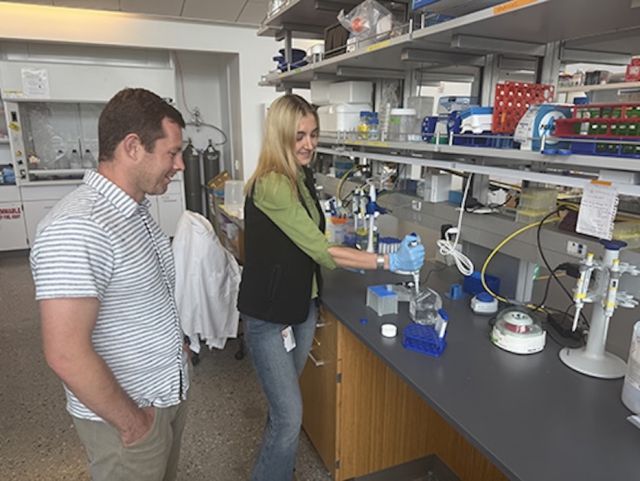
Credit to Cameron Walker:
In 2020, right when Jane Baude was starting her PhD research, she learned that a critical
component of her experiment — the gel needed to grow and test mammary epithelial cells
—wouldn’t be available for nearly a year because of pandemic-related production issues. So,
she and her adviser, UCSB professor Ryan Stowers, decided to pivot. Instead, Baude would
engineer her own gel to study cells.
Now Baude, Stowers, and their colleagues have created an algae-based gel in the lab as a
platform for studying mammary epithelial cells, which form milk-producing ducts and glands in
healthy breast tissue and can also transform into cancer cells. “Not only did we create
something that can mimic commercially made gels, but we were able to use what we’ve made
to our advantage to learn more about the cells and the material,” Baude says.
In research published September 26 in the journal Science Advances, they demonstrate that
their gel successfully supports the development of normal mammary gland tissue and can be
modified to direct how cells grow. By adjusting the mechanical and biochemical properties of
the gel, researchers can learn more about how cells in the body are shaped by their physical
environment.
Looking at the relationship between cells and their physical environment may offer new
insights into how cancer develops. Historically, cancer research has focused on how mutations
initiate a cascade of signals that drive tumor growth, Stowers says. “The environment the cell
grows in is just as important as its genetics. You can put the same cells in different
environments, and they might behave like normal cells, or they might behave like invasive
malignant cells, just by changing the context that they're growing in.”
The gel environment that the researchers created can provide new insights into how the
‘neighborhoods’ that cells inhabit in the body can send cells down developmental pathways
that lead toward cancer, says Stowers, who has joint appointments in the Departments of
Mechanical Engineering and Bioengineering.
“Basement Membranes” Direct Epithelial Cells
In your body, the neighborhood where epithelial cells live is called the basement membrane.
“All the epithelial cells in your body are surrounded by this very thin mesh of proteins that
anchors cells in place, providing support while also playing an important role in cell signaling,”
Stowers says.
As a result, researchers who study epithelial cells in the lab need an equivalent basement
membrane to understand how these cells act in their environment. Most commercially
produced reconstituted basement-membrane products made for studying breast cancer and
breast tissue are extracted from mouse tumors.
While traditional gels are widely used, ”Everybody knows they’re not perfect,” says Stowers,
who has done previous work with algae-based gels.
As he and Baude began to work, he recalls, “We thought, why don't we try to overcome some
of these limitations? If we're going to go through the effort of designing a new gel, we can try
to start from scratch and engineer some tunability and modularity into the synthetic system
that we're trying to develop.”
Stiff Basement Membranes Linked to Tumors
Cells respond to the physical properties of what surrounds them, whether in the lab or in the
body — so being able to adjust the properties of a membrane in the lab gives researchers more
insight into how cells react to different environments. “Cells are particularly mechanosensitive,
so they can feel the difference between a soft gel and a hard gel, for example,” says Stowers,
who focuses his research on how cells interact with the mechanical properties of their
environment.
Those interactions can play a role in cancer. Recent research has linked stiffer surrounding
environments to tumor development. “Oftentimes, when people feel a stiff lump, they go get it
checked out, knowing intuitively that this hard mass, this stiff lump, is potentially bad,” Stowers
explains. “The mammary gland is one of the softer tissues in the body, but a malignant tumor
actually increases in stiffness as disease progresses.”
New Gel Adds Precision, Flexibility
To develop the synthetic basement membrane, Baude used a previously studied algae-based
gel and tested combinations of short peptide sequences until it matched the capabilities of
Matrigel, a commercially available gel for studying mammary cells. She and her colleagues also
varied the crosslinking and length of polymer chains in the gel to modify its stiffness and how
quickly it responds to applied force. “We found a combination of mechanical and biochemical
cues that work well,” she says. “Some of the changes we were able to make in the gel help us
pick apart how different kinds of matrices contribute to cell development.” Additional
modifications also allowed the researchers to mimic a matrix that makes cells more likely to
become cancerous.
In the right conditions, cells placed in the gels were able to make their own basement
membranes, Stowers says. “But when we supply the wrong cues, they start making other
proteins and don't develop in the right fashion.”
Stowers and his colleagues are interested in exploring the extent to which they can control the
initial conditions of the gel to shape cell development, including the possibility of using the gel
to grow complex tissues and organs from patient cells. “We’re hopeful,” he says, “that by
applying an engineering approach to developmental biology, we can uncover insights into how
to guide the formation of complex, functional engineered tissues.”
